Look, trace and copy: choosing practice rows
Choose a solid model, light tracing and blank writing rows to suit your next practice sheet.
Look, Trace and Copy give each row a different job. Look shows a solid model, Trace adds pale letters to trace over, and Copy leaves empty guidelines for writing on your own. Choose the rows you need for the activity.
Give each row one clear role
| Row | What appears | What to check |
|---|---|---|
| Look / model | Solid printed text | All letters and punctuation are present. |
| Trace | Light-gray printed text | The lettering remains visible on your printer. |
| Outline | An outline around each printed letter | Use it to trace the letter shape; it does not show stroke order. |
| Copy / blank | Guidelines without lettering | There is genuinely empty room for independent writing. |
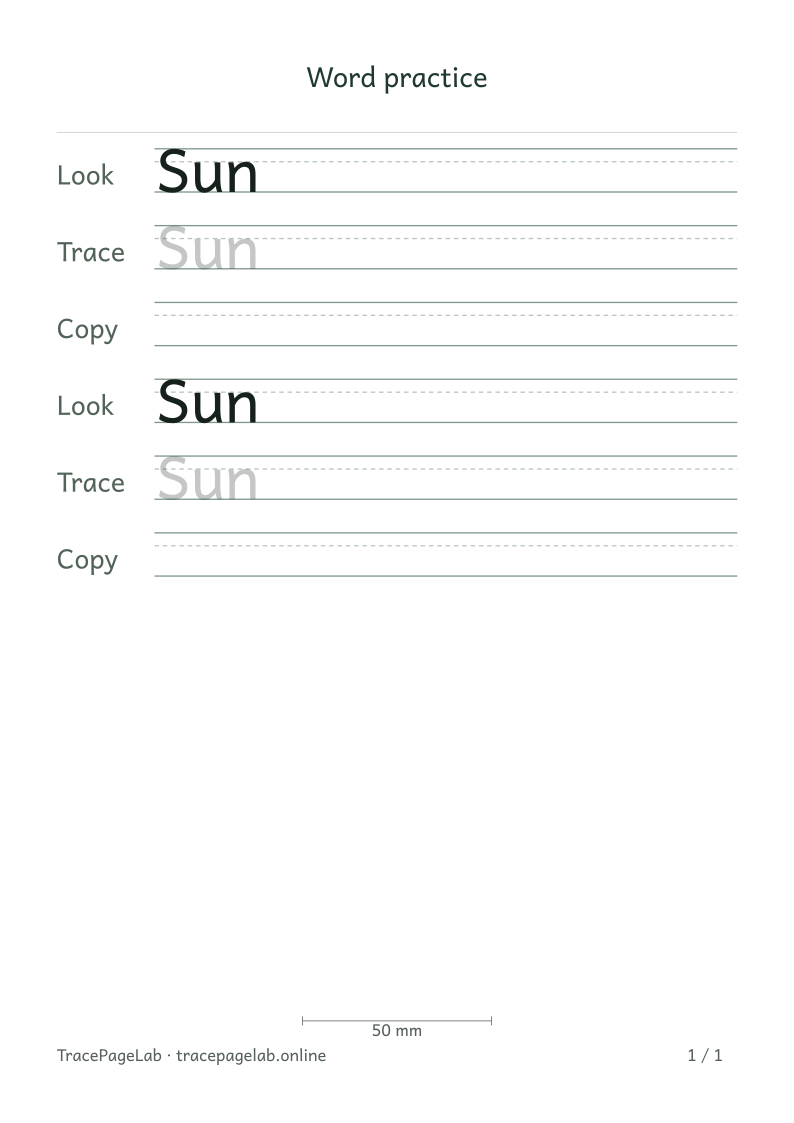
Read the solid model, inspect the pale trace row, and leave the copy row empty.
Repeat the sequence, not just the text
For one short word, a Look–Trace–Copy pattern repeated twice makes six rows: Look, Trace, Copy, then the same three again. Repeat sequence applies to the whole pattern, not just the tracing row.
A sentence that wraps needs more than one line. Check each preview page to see where its practice rows continue before deciding how many repetitions to use.
Adjust contrast with the printer in mind
Light tracing can be harder to see on paper than on a bright screen. Print one sample and adjust Trace darkness if needed. Line darkness controls the guidelines separately.